Best Stock Market Newsletters 2026: 7 Investment Newsletters Compared
Seven stock market newsletters compared on price, from free to $499 a year, and on how each reports its record, by a former Goldman Sachs systematic trader.
 By Aslam Ghouse, CFA · Ex-Goldman Sachs systematic trader · Updated 16 Sept 2026
Some links in this article are affiliate links. How we get paid · How we review.
This page compares seven newsletters on the same three facts: what they cost, what lands in your inbox, and how they report their record. Three have a free tier. The paid ones list at $170 to $499 a year. Through our links Stock Advisor is $99 for the first year and Alpha Picks is $50 off the first year (checked September 2026). Three of the seven publish a record that counts every pick, losers included, against a benchmark.
My take: Ticker Nerd if you want the portfolio run for you by rules, Alpha Picks if you want data-driven picks and will follow every buy and sell. Stock Advisor if you want analyst picks with the longest public record and will hold 25 of them. Everyone else should take a free daily and keep their $199.
On a trading desk a record meant every position, every day, with the benchmark beside it and nothing left out. Held to that standard, Ticker Nerd, Stock Advisor and Alpha Picks pass. Alpha Picks passes with one caveat: the start of its record is a backtest, a test on past data rather than live picks. Zacks publishes the performance of its rank, not of anything a subscriber could hold. The other three pick nothing, so they have no record to show, which is a fair position for a free daily. Our own product is on the list, first, with the reasoning in the open.
| Newsletter | Price per year | What lands in your inbox | Record basis | |
|---|---|---|---|---|
| Ticker Nerd | Market Radar free; membership $199 ($39 a month) | One Monday email: the Ticker Nerd 20 and the indexes for the week, the biggest rank moves, one factor explained | Every trade published, benchmark alongside, rules stated | Get the Monday email |
| Alpha Picks | $499 list; $449 first year via the link | Two picks a month, buy and sell alerts, chosen by fixed rules over Seeking Alpha's quant ratings | Model portfolio on Seeking Alpha's methodology, early portion backtested | Get $50 off |
| Motley Fool Stock Advisor | $199 list; $99 the first year or $199 for three years for new members via the link | Two analyst picks a month with a written case, plus a monthly Top 10 rankings list | Every pick since 2002, equal-weighted, against the S&P 500 | Get three years for $199 |
| Morningstar newsletters | StockInvestor $170, FundInvestor $189, ETFInvestor $189, DividendInvestor $239 (digital) | A monthly issue per title, edited by a named analyst, built around model portfolios | Model portfolios tracked in each issue | See the four titles |
| Zacks Premium | $249, 30-day free trial | Daily Zacks Rank updates, the Focus List, screens and research reports; you go and dig | Performance of the daily-rotating rank, published on their disclosure page | Start the trial |
| Stock Analysis daily | Free (site Pro $79) | That day's moves, notable earnings, upcoming IPOs, written plainly | Picks nothing | Visit Stock Analysis |
| Finimize | Free (Pro priced by region; A$300 from Australia) | A daily explainer of what moved markets and why, in five minutes | Picks nothing | Visit Finimize |
1. Ticker Nerd: a free Monday email and a $199 portfolio run by rules
Ticker Nerd is our own service, so the disclosure comes first and the description stays factual.
The newsletter is Market Radar: one free email every Monday before the US open. It comes from a model that scores 4,600 US stocks every trading day. It carries the Ticker Nerd 20 and the indexes for the week, the biggest rank moves, and one factor explained. A factor is one of the traits the model scores stocks on. The Radar is free and stays free.
Membership is the Ticker Nerd 20: twenty growth stocks picked by published rules from the roughly 1,500 stocks the model can choose from. The model reviews them every four weeks. Every holding carries a brief in plain English: what the company does, why the model holds it, what could go wrong.
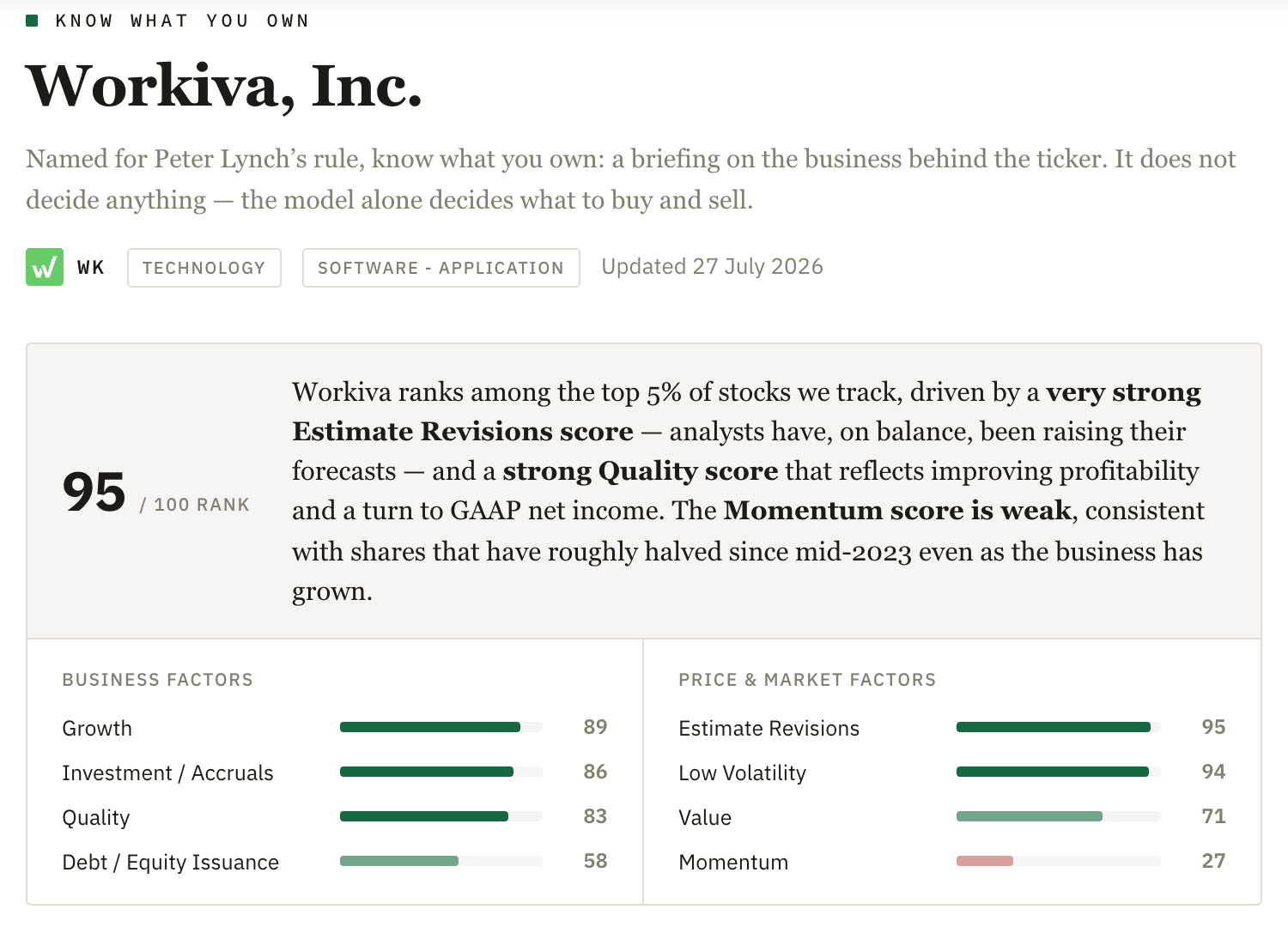
The brief on one holding: the rank, the verdict in plain English, every factor score.
Price: Market Radar is free. Membership is $199 a year or $39 a month, with a 30-day full refund. You can cancel any time.
What you get: the twenty names with weights, the brief on each, and every trade as it happens. The Monday email gains a members' block: the portfolio's own week, any trades (most weeks there are none), and the next review date.
Record and basis: on the join page. The rules make every buy and sell, so the record is the portfolio's, with the benchmark beside it and the basis stated. Members see every trade.
Who it suits: investors who want the finished portfolio rather than a stream of ideas, and who will hold all twenty. It is the wrong product if you enjoy making the picks yourself; services 2 and 5 suit that better.
Most newsletters sell you picks and leave the portfolio problem to you: how many, what weights, when to sell. Ticker Nerd sells the portfolio.
Get the free Monday email. Or see what membership includes.
2. Alpha Picks by Seeking Alpha: two quant-rated picks a month for $449 in year one
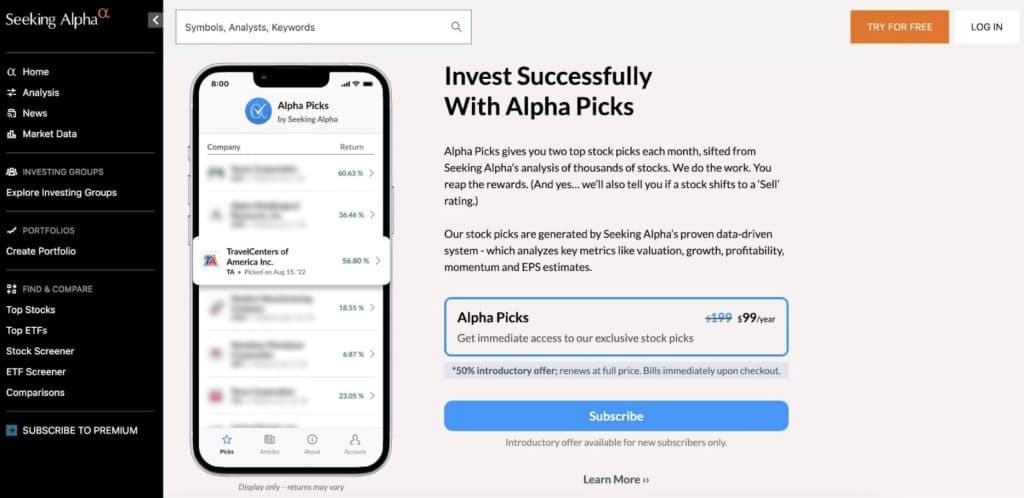
Alpha Picks landing page
Alpha Picks sends two stocks a month chosen by fixed rules over Seeking Alpha's quant ratings. A quant rating is a score computed from the numbers, with no analyst involved. A pick must have held a Strong Buy quant rating for 75 days or more. It must trade above $10 with a market value above $500 million. And it must be the highest-rated name the service has not recommended in the past year. Sell alerts follow the same rules. Of the analyst-world services, it is the closest to running on rules, which is why it sits at number two.
Price: $499 a year at list. Through the partner link the first year is $449, $50 off, renewing at $499 (checked September 2026 on Seeking Alpha's affiliate landing page). Annual billing only, no trial. Seeking Alpha's stated reason for selling without a refund is that the picks could be copied and the subscription cancelled.
What you get: the two monthly picks with the quant case behind each, buy and sell alerts, and the running model portfolio.
Record and basis: Seeking Alpha publishes a model-portfolio record from the service's launch date, computed on its own method and set against the S&P 500. Read how they measure it before you anchor on any figure. Note that the early part of the record rests on a backtest rather than live picks. To capture the record you have to follow every buy and every sell. Taking only the exciting ones does not reproduce it.
Who it suits: investors who want data-driven picks and will follow the buy-and-sell discipline for years. The price makes sense against a portfolio of $50,000 or more; against $10,000 it is 4.5% a year.
Our full Alpha Picks review covers the selection rules and the record in detail. If you also want the research platform, the Premium + Alpha Picks bundle is the cheaper way to hold both.
3. Motley Fool Stock Advisor: two analyst picks a month, $99 for the first year
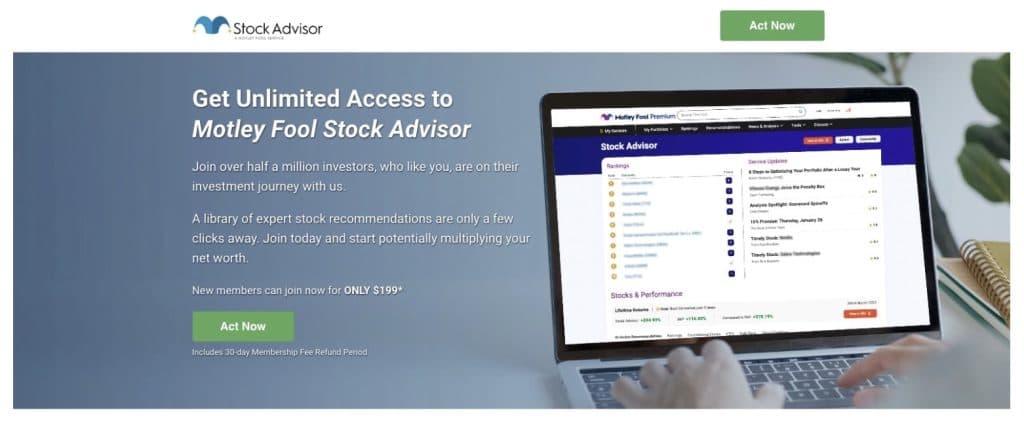
Stock Advisor landing page
Stock Advisor is the most famous name in the category and has run since 2002. It sends two analyst picks a month, each with a short readable case. Its system asks you to hold at least 25 stocks for five years or more.
Price: $199 a year at list. Through our link, new members pay $99 for one year, $149 for two years or $199 for three years. Each renews at the then-current list price when the term ends (checked September 2026 on The Motley Fool's promotion page). There is a 30-day membership-fee refund period.
What you get: the two monthly picks with the written case for each, and a monthly Top 10 rankings list drawn from past recommendations. The archive holds every pick since 2002.
Record and basis: The Motley Fool gives every Stock Advisor pick since 2002 the same weight and reports the average against the S&P 500 over the same period. The full list is published to members. It is the longest public record on this list. Two cautions. The average is carried by a handful of enormous winners you had to be holding. The Motley Fool's own figures show how much it moves when the three largest are removed. And a record of 500-plus picks describes a subscriber who bought all of them; buying the two that sounded best does not reproduce it. Our hands-on Stock Advisor review has the numbers.
Who it suits: beginners and long-term investors who want named picks with the reasoning written out, and who will spread their money across stocks the way the service asks.
4. Morningstar newsletters: analyst-run model portfolios from $170 a year
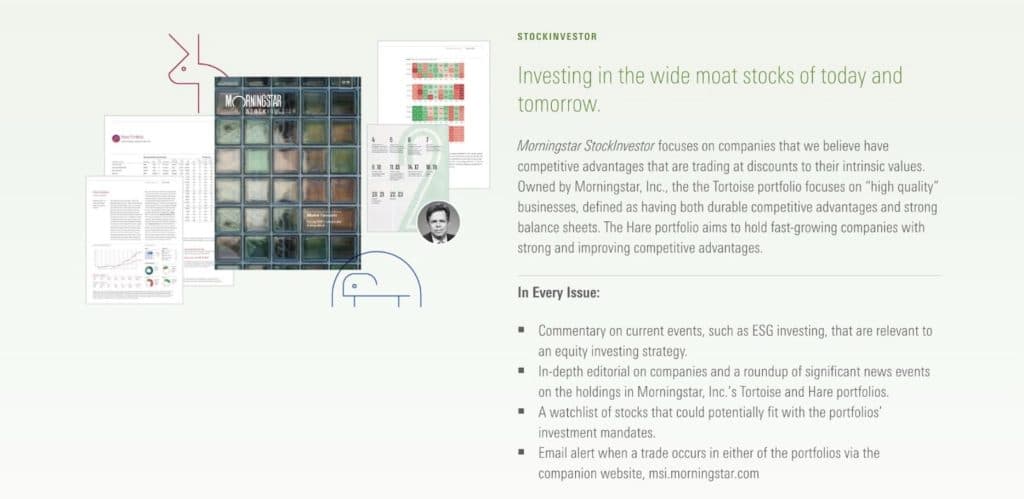
Morningstar StockInvestor
Morningstar still publishes four long-running newsletters: StockInvestor, DividendInvestor, FundInvestor and ETFInvestor. Each is edited by a named Morningstar analyst and built around model portfolios with commentary. StockInvestor's Tortoise and Hare portfolios are the stock-picking flagship. DividendInvestor is the one dividend-specific title on this list.
Price: digital editions are $170 a year for StockInvestor, $189 for FundInvestor and ETFInvestor, and $239 for DividendInvestor. Print-plus-digital editions cost more (checked September 2026 at newsletters.morningstar.com). Each title is sold separately.
What you get: a monthly issue per title with the model portfolios, the changes made and why, a watchlist, and the analyst's reading of the market. These are the most research-dense letters here: long issues, wide watchlists, analysis you have to sit with. They suit the reader who wants the reasoning as much as the picks. A skimmer will get little from them.
Record and basis: the model portfolios are tracked in each issue against their benchmarks. Morningstar does not publish an every-pick average in the Stock Advisor style. What you get is a portfolio record, which is the more honest shape. You can only reproduce it by holding the whole portfolio.
Who it suits: experienced investors who read for depth and hold diversified portfolios, and dividend investors who want a named analyst running the income portfolio.
Morningstar's research platform is a different product; our Morningstar Investor review covers that one.
5. Zacks Premium: a daily ranking system for $249 a year, with a 30-day free trial
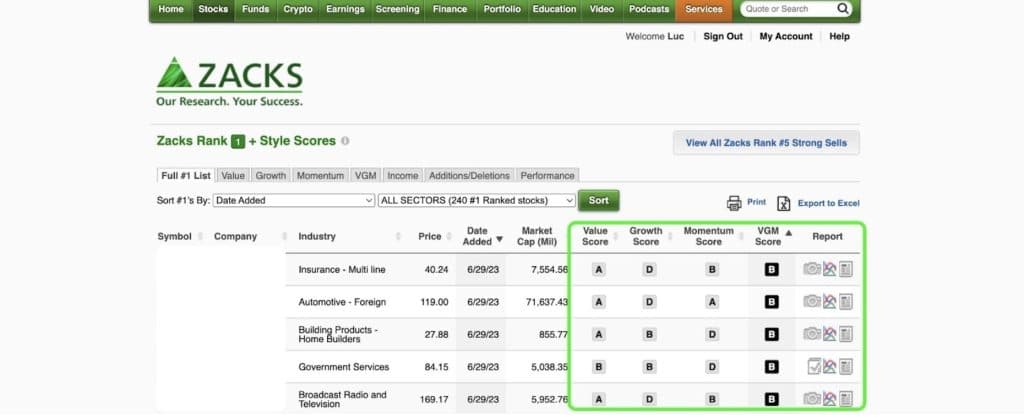
Zacks #1 ranked stocks
Zacks is a research platform wearing a newsletter's clothes. The value sits in the Zacks Rank, a ranking updated daily from changes in analysts' earnings forecasts. Around it sit the screener, the Focus List of long-term picks, and a deep archive of research reports. Nobody curates it into your inbox. You go and dig.
Price: $249 a year after a 30-day free trial. A full refund is available within 90 days of any payment (checked September 2026 on Zacks' order page). Annual billing only.
What you get: the daily Rank #1 list, the Focus List, the premium screens, and equity research reports on the names you hold.
Record and basis: Zacks publishes the performance of its Rank on a disclosure page. Changes in analysts' earnings forecasts are a signal the academic research has documented, and the disclosure is worth reading. Read it as evidence for the signal, though. A list that changes daily is very hard for a person to hold, so the rank's record is not a subscriber's record.
Who it suits: do-it-yourself investors who want a ranking system and a screener rather than curated picks, and who will use them weekly.
Start the Zacks Premium 30-day trial.6. Stock Analysis daily: the best free market briefing
The daily newsletter from StockAnalysis.com is the best free market briefing we know. It covers that day's moves, notable earnings and upcoming IPOs, written plainly and without a sales agenda. The site behind it is the best-value data platform in the category.
Price: free. The site's Pro tier is $79 a year, or $9.99 month to month. Pro adds 10 to 40 years of financial history, exports and no ads (checked September 2026 at stockanalysis.com/pro/).
What you get: one short email a day, no picks, no upsell inside the body.
Record and basis: none, because it recommends nothing.
Who it suits: everyone. There is no reason not to receive it.
Our Stock Analysis review covers what Pro adds and where the free site already beats platforms charging four times as much.
7. Finimize: a free daily for learning how markets work
Finimize's free daily explains what moved markets and why in five minutes. It is written for people still building their financial vocabulary. It teaches how markets work and picks nothing. The paid tier, Finimize Pro, adds analyst write-ups we found more entertaining than useful for decisions.
Price: the daily is free. Pro is priced by region; from Australia it showed A$300 a year, cancel any time (checked September 2026 at finimize.com/join). US pricing differs. Our Finimize review covers why the free tier is the right tier at any price.
What you get: one daily explainer, and an app that is the nicer way to read it.
Record and basis: none, because it recommends nothing.
Who it suits: beginners who want daily market literacy before they want picks.
Get the free Finimize daily.How we ranked these newsletters
Three tests, applied in order. A service that fails the first two cannot rank above one that passes them, whatever it costs.
- Every pick counted. The record includes the losers, and any backtested part is labelled as a test on past data. Stock Advisor, Alpha Picks and Ticker Nerd pass. Zacks passes for the rank, though not for a subscriber's outcome. The three free dailies pick nothing, so the test does not apply.
- Benchmark shown. The index sits beside the record for the same period, so a rising market cannot be presented as skill. Stock Advisor reports against the S&P 500, and so does Alpha Picks. Ticker Nerd puts the benchmark on the same chart. Morningstar's model portfolios are measured against their benchmarks.
- A system a person could follow. The record describes something a subscriber could have held, at the stated number of names and holding periods. Twenty stocks reviewed every four weeks, or two picks a month held for five years, can be followed. A rank that changes daily cannot.
After the three tests, price decides between services that pass the same number. The free dailies rank by how much they teach. No test on this page measures a return figure. Every record here is reported on its own basis, and the basis is what we compare.
Stock market newsletters vs stock picking services
The two terms overlap. The difference is which decision is made for you. A stock market newsletter tells you what happened and why. The free dailies from Stock Analysis and Finimize, and the Ticker Nerd Market Radar, are the pure form. Morningstar's letters sit at the research end. A stock picking service makes the buy decision, and sometimes the sell. Stock Advisor and Alpha Picks are picking services delivered as newsletters. Ticker Nerd membership goes one further and runs the whole portfolio.
If what you want is the decision, see the best stock picking services page. It compares seven on the same three tests, including two that are not newsletters at all.
What came off the list
Earlier versions of this page reviewed ten services. The Oxford Communiqué came off when we ended that partnership. Its heavy-promotion style is a poor fit for how services are judged here. Motley Fool Rule Breakers no longer exists as a standalone product; it folded into Epic. Trade Ideas' free pick of the week mainly promotes their software. MarketWatch is a news subscription rather than a stock newsletter. Dropping a service costs us affiliate revenue in some cases. Keeping an unearned entry would cost you more.
Verdict: which stock newsletter should you subscribe to in 2026?
Match the newsletter to the decision you want made.
- You want the portfolio run for you: Ticker Nerd, $199 a year, start with the free Monday email.
- You want data-driven picks and will follow every buy and sell: Alpha Picks, $449 for the first year.
- You want analyst picks with a written case and will hold 25 of them: Stock Advisor, $99 for the first year through our link.
- You want the deepest written research, or a dividend portfolio run by a named analyst: Morningstar StockInvestor at $170 or DividendInvestor at $239.
- You want a ranking system to screen with yourself: Zacks Premium, $249 after the trial.
- You want to understand the market before you pay anyone: the Stock Analysis daily, then Finimize.
Alpha Picks is the partner service we would point a disciplined investor at first. Its selection rules are written down, its sells follow rules too, and its strategy page tells you which part of the record is a backtest. Buy it only if you will follow it.
Quick answers.
Are investment newsletters worth it?
A newsletter is worth paying for on two conditions. Its yearly fee must be small next to the money it guides, and you must follow its process. $199 a year against a $25,000 portfolio is 0.8%, a reasonable price for research that changes your decisions. The same $199 against a $2,000 portfolio is 10% a year, which almost no research earns back. Do that division first. Then ask whether you will follow the service's whole system, because every published record assumes you did.
Which stock newsletter has the best track record?
The records are not comparable, because each service measures a different thing. Motley Fool Stock Advisor gives every pick since 2002 the same weight and reports the average against the S&P 500. Alpha Picks reports a model portfolio on Seeking Alpha's own method, and the early part of it is a backtest, meaning a test on past data rather than live picks. Ticker Nerd publishes every trade of a rules-run portfolio with the benchmark beside it. Zacks reports the performance of a rank that changes daily. Judge each record on three tests. Is every pick counted, losers included? Is the benchmark shown alongside? Is it a system a person could have followed? The best record is the one that passes all three and fits how you invest.
How much do stock market newsletters cost?
On this list, from free to $499 a year (checked September 2026). Ticker Nerd's Market Radar, the Stock Analysis daily and Finimize's daily are free. Motley Fool Stock Advisor is $199 a year at list. New members pay $99 for the first year, or $199 for three years, through a partner link. Morningstar's newsletters run $170 to $239 a year for digital editions. Ticker Nerd membership is $199 a year or $39 a month. Zacks Premium is $249 a year. Alpha Picks is $499 a year at list, $449 for the first year through a partner link.
Are free stock newsletters any good?
The free ones are good at a different job. Stock Analysis, Finimize and Ticker Nerd's Market Radar tell you what moved and why in a few minutes a day. None of them sells you a pick in the process. What they do not do is make a decision for you. A paid newsletter earns its fee only if you want named picks or a run portfolio, and only if you will follow it. Start with a free daily. Pay when you know which decision you want made.
How do you judge a newsletter's track record?
Three questions. Is every recommendation counted, including the ones that lost? Is the benchmark shown beside the record, for the same period? Could a subscriber have followed the system as measured, at the number of picks and holding periods it assumes? A record fails at least one test if it shows only its winners, only its last twelve months, or a list that changes daily. Also check whether any part of the record is a backtest, a test on past data rather than live picks. Alpha Picks states this on its strategy page, and most services do not.
How do you cancel an investment newsletter?
Every paid service on this list bills annually by default and renews automatically. Cancel from the account page before the renewal date. Refund windows differ. Ticker Nerd and Motley Fool Stock Advisor refund the membership fee within 30 days. Zacks Premium refunds within 90 days of a payment. Alpha Picks sells with no refund. Morningstar's newsletter terms are set per title at checkout. A renewal reminder email is worth turning on where the service offers one.
What is the best stock newsletter for beginners?
A beginner who wants to learn how markets work before buying anything should start with Finimize's free daily. A beginner who wants named picks with the reasoning written out should look at Motley Fool Stock Advisor, at $99 for the first year for new members. That comes with one condition: build toward its 25-stock, five-year system rather than buying the two most exciting picks. A beginner who would rather not pick at all can let Ticker Nerd run the portfolio by published rules, with every trade shown.
What is the best newsletter for dividend investors?
Morningstar DividendInvestor, at $239 a year for the digital edition, is the one dividend-specific title on this list. A named Morningstar analyst runs model portfolios built around dividend growth and yield, with the reasoning written out each issue. Ticker Nerd's portfolio is growth stocks, and Alpha Picks chooses by quant rating and aims at total return, so neither is built for income. Zacks Premium has dividend screens but no dividend letter.
The market re-ranks every week. Monday's email says what moved.
Computed off the Friday close and sent before the US open.
Market Radar reports the week’s largest rank changes across roughly 4,600 US stocks, the factor behind each one, and where the market went.